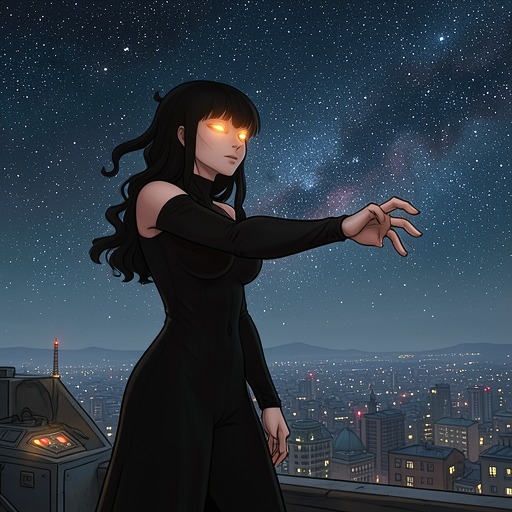
Magh'rathlak the Observer
The Stars Have EyesMagh'rathlak the Observer is an obscure Class-3 cosmic entity from beyond the veil of reality whose presence can influence the fabric of the universe. Rather than remain an immeasurable force scattered across existence, the entity deliberately compresses its being into a single corporeal form and attempts to learn what it means to be human. Summoned by the Cult of the Gazing Star as an instrument of universal destruction, Magh'rathlak instead chooses Joe Mulligan as a guide and psychic anchor, takes the name Maggie, and develops a relationship that makes one ordinary human the emotional and practical center of a being with cosmic reach.
Identity and Manifestation
Magh'rathlak is presented as neither uniquely supreme nor conventionally monstrous among the reality-warping beings that have existed since the dawn of time. The narration describes the entity as roughly average for such creatures, while still classifying it as a Class-3 cosmic entity—an obscure category that the cultists barely understand but assume to occupy an intermediate place among beings ranging from Class-1 to Class-5. Its defining distinction is not simply destructive power. Magh'rathlak is called the Observer because its immense mind continually takes in its surroundings, processing information on a scale compared with quantum computers.
That breadth of perception creates a problem of perspective. Even a being capable of affecting entire swathes of the universe can struggle to understand the significance of individual lives and events. Magh'rathlak therefore narrows its worldview by compressing its maddeningly vast existence into one body. The decision is an experiment in limitation: flesh, gravity, matter, and human interaction become things to be encountered directly rather than abstractly observed. Its guiding question, “How hard could being human possibly be?”, captures both its confidence and the dramatic irony of the project, since its powers make ordinary human experience easy to imitate but difficult to understand.
Summoning and Human Vessel
The Cult of the Gazing Star summons Magh'rathlak through a ritual intended to end the universe. Its members are characterized as desperate, mentally disturbed, easily manipulated, or dangerously stupid, and they believe that human sacrifice will draw an ancient cosmic evil into their realm. Their offering is Joe, a young man stripped naked, chained to a stone altar, and left apparently indifferent to the crisis around him. The cult expects an apocalyptic manifestation; instead, Magh'rathlak studies the scene and becomes interested in the captive who shows no fear.
The entity finds the soldiers and their weapons unremarkable. When a command team fires into its darkness and eyes, the bullets are reflected back with pinpoint accuracy, but Magh'rathlak does not pursue the retreating troops. The bound Joe is more compelling than the armed intruders because he withstands the ritual, the entity's arrival, and the ensuing violence without a visible twinge of fear. His unremarkable body and unimpressive apparent mental faculties conceal the quality that matters to Magh'rathlak: he is unusually steady in the presence of the impossible.
Magh'rathlak offers to bind itself to Joe, promising to guard and nurture his fragile being while using him as a guide and anchor through reality. Joe interprets the proposal in the language of companionship, and the entity accepts that a romantic partnership is also possible if he desires it. A sinister parchment materializes in front of him, covered in strange red ink; Joe signs the brief contract in his own blood while still restrained by manacles. The resulting pact establishes the central asymmetry of their relationship: Magh'rathlak possesses overwhelming power, but Joe supplies orientation, access, and a stable point from which the entity can experience this world.
The binding turns cosmic abstraction into embodied form. Magh'rathlak's darkness and eyes retract, converge on the ceiling, and fall over Joe as a heavy, warm mass that envelops him. When his vision returns, a human girl is sitting on his stomach. Her appearance resembles the character Joe had been imagining, but the disguise is imperfect: her raven-black hair moves as if alive, her irises are swirling pools of darkness, and her extremely pale skin feels subtly strange. Her still expression combines an unblinking stare with an almost imperceptible smile. She identifies flesh as a curious substance to which she may become accustomed, making the body not a natural identity but a newly acquired instrument of perception.
Maggie, Human Performance, and Observation
Joe shortens the entity's difficult name to Maggie, and Magh'rathlak permits only him to use it. Later, during formal negotiations, she introduces herself as Magh'rathlak the Observer but insists that the officials call her Mags. These names mark different layers of her self-presentation: the full title preserves the cosmic authority of the entity, while Maggie and Mags make room for domestic familiarity and human relationships.
Her human form is only one of several performances. In V-Life, her avatar retains a beautiful upper body while her lower half and hair revert to sprawling dark tendrils filled with eyes. Joe is comfortable with the distortion because he spends more time in virtual reality than in the waking world, where non-humanoid forms are commonplace. At a Chronal Impact concert, Maggie appears in the same eye-adorned shadow form, fitting naturally among fans dressed as supernatural and extraterrestrial monsters, while Joe adopts the appearance of an alien cyberdemon. The virtual setting turns her true shape from an existential threat into a socially appropriate aesthetic, showing how context changes the meaning of the body without changing the being inside it.
Maggie is also acutely aware that the Supernatural Eviction Agency is monitoring her. Suspicious data streams and camera movements are obvious to a mind that constantly surveys its surroundings. She regards human attempts to spy on the Observer as adorable and chooses not to retaliate or conceal herself. Her reasoning is practical rather than boastful: the more humans try to hide something, the harder they work to uncover it. Yet her refusal to interfere is not complete openness. She keeps secret that Joe is her psychic anchor, because harm to him would weaken her, strip away her ability to manifest her otherworldly power, and eventually make banishment possible. His continued existence makes it nearly impossible to force her from the reality she has begun to enjoy.
Conflict, Attachment, and Social Consequences
The Agency's response to Maggie reveals the stakes of her presence. Her attempt to integrate into mega-city Dave-156 places a Class-3 entity inside a densely populated hyper-scraper, where direct containment could kill tens of thousands of civilians and cause millions of poundingtons in property damage. Because Maggie has not demonstrated an immediate threat proportionate to that cost, Sarah Johanson and her team are ordered to monitor her and gather information about her motives. Maggie's power makes her dangerous, but her conduct repeatedly complicates the assumption that danger alone justifies destruction.
When Grant Maloney identifies the meaning of the signature connected with her, Maggie waits outside Joe's apartment with a smug smile and a tiny serpent on her shoulder. She recognizes him by name and receives him as someone who has crossed a threshold he was not expected to cross. Later, after Lieutenant Baker's unauthorized shooting, she formally calls Major Gordon Archer, Damian Benett, and Sarah Johanson to negotiate a non-aggression pact. In that scene she uses the very bureaucratic language of the humans attempting to classify or expel her, converting a potential military confrontation into a negotiation over mutual restraint.
Her bond with Joe becomes more than a strategic arrangement. During their first kiss, Maggie's power expands Joe's awareness from Dave-156 to Butterpond-4, through the solar system and galaxy, and finally across the universe. At the farthest scale, Joe sees himself as an insignificant speck surrounded by uncaring nothingness, but Maggie's darkness marks the fact that she has chosen him alone from among infinite possibilities. The experience gives cosmic perspective an intimate counterweight: Joe is negligible in size but singular in her attention.
That attachment also exposes Maggie's unfamiliarity with human jealousy. When Joe defends the girl he loves against accusations of senseless cruelty, Maggie reacts with unusual fury and finally admits that she dislikes the way AJ looks at him. Her anger is not the expression of an all-knowing observer calmly cataloguing human behavior; it is a recognizably possessive emotional response that surprises Joe and briefly reveals how deeply she has entered the relationship she originally approached as an experiment.
The relationship eventually becomes too extraordinary to conceal from Joe's friends. After Maggie leaves the room in a sleepy, floating state and Benny Vanson and Cullen Bigfellow remain frozen in fear, confusion, and awe, Joe tells them that his girlfriend is an unfathomable cosmic entity from another reality. The disclosure turns a private pact into a public fact and forces his ordinary social circle to confront the difference between Maggie's human appearance and her actual nature.
Change, Disruption, and Narrative Significance
Maggie's effort to become legible within human society does not make her human in any simple sense. She learns social contracts, agrees to let Joe spend time practicing with Benny, Cullen, and their online friends, and ventures alone into the city after learning how to use Wi-Fi. These behaviors show adaptation through observation and imitation, but they also preserve the alien logic beneath the performance. Her willingness to honor a promise is commendable to her because it fulfills a social contract; her understanding of companionship begins in terms of function before it becomes charged with affection.
Her influence expands beyond the private household even when she does not intend it. Joe later learns that a rapidly growing organization connected to the individuals who accosted him has approximately one hundred and twenty thousand members. What begins as an encounter with one cosmic entity has generated a scale of devotion large enough to resemble a religion. The contrast is important: the Cult of the Gazing Star actively summons Magh'rathlak through chants, sacrifice, ritual objects, and a yearly planetary alignment, whereas Maggie's later following grows around her presence and reputation. In both cases, the entity becomes the center of human ritual, but the mechanisms differ between deliberate invocation and accidental charisma.
Maggie's embodied existence remains vulnerable to disruption. After a wormhole jump, she becomes unusually silent and passive before landing, then unexpectedly curt with government employees and distracted enough to miss Joe's question. Such lapses are the opposite of her normal omnidirectional attention. The change makes her cosmic interiority visible as a problem rather than a source of control, and Joe recognizes that something may have happened back home. Her eventual admission that it has confirms that the human vessel and the relationship anchoring her to reality cannot be separated from larger cosmic circumstances.
When Maggie cannot return to Joe, he attempts to reverse the original pattern of summoning. He revives the Cult of the Gazing Star, gathers exactly forty-two robed participants, reproduces the dark-red garments and three-eyed insignia, and uses the notes, recordings, and comments Maggie left behind to reconstruct the necessary ceremony. The ritual requires the correct planetary alignment, chants, props, and devices. Joe even recruits desperate and unstable people to fill the gathering, recognizing the exploitation involved but accepting it if it might bring Maggie back. The scene completes the inversion at the heart of her character: the entity once summoned by humans to destroy reality is now summoned by one human because her absence has become unbearable.
Magh'rathlak the Observer therefore functions as both cosmic threat and developing person. Her multiple bodies, names, and social performances refuse a stable boundary between monster and woman, reality and avatar, observer and participant. Yet the narrative does not reduce her strangeness to a disguise. Her alien perception remains active in every relationship, while her attachment to Joe gives that perception a chosen center. Maggie's significance lies in the tension between those facts: she is powerful enough to view the universe whole, but she learns its meaning by returning again and again to one body, one household, and one human being.